

In the flexibility world, there are two schools: those who hold long, still stretches — and those who use muscle power to work deeper. The truth is you need both. But understanding the difference changes your training.
Passive flexibility
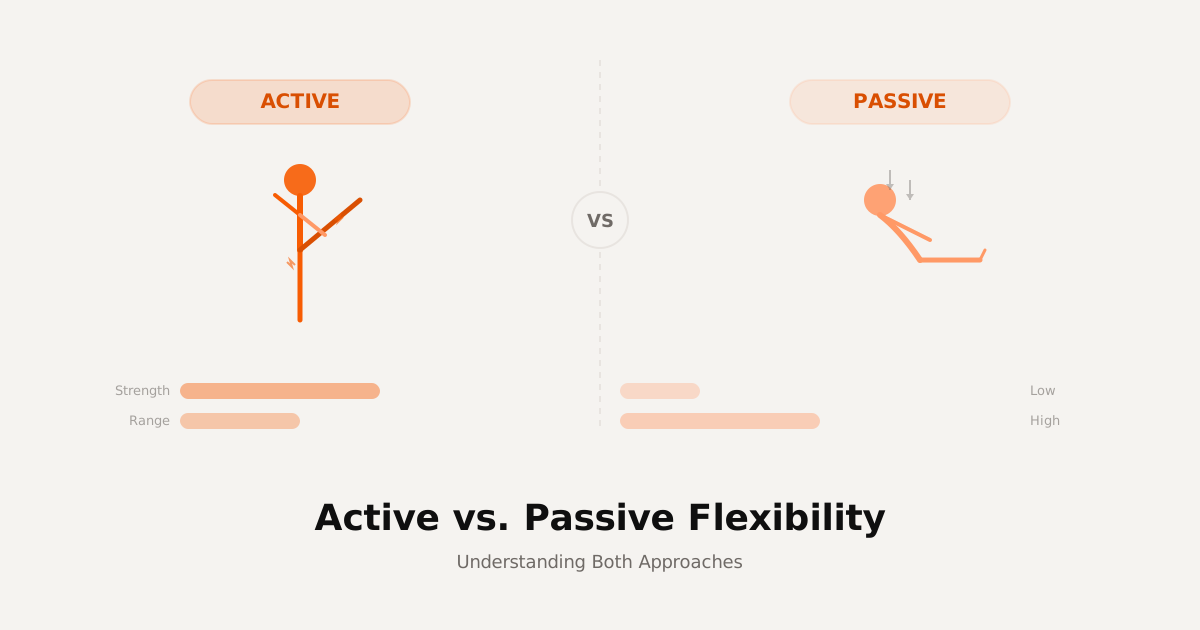
Passive flexibility is the maximum range of motion you can achieve with help from gravity, a partner, props, or your own body weight. Think of it as "what your body allows when you relax."
- Examples: Yin yoga poses held for 2-5 minutes, forward folds with gravity, splits with bolsters
- Benefits: Affects connective tissue and fascia, increases total range of motion, calming for the nervous system
- Limitation: You don't have strength or control at end range — your body doesn't "own" that movement
Active flexibility
Active flexibility is the range of motion you can achieve using your own muscles. Think of it as "what your body can control."
- Examples: Lift your leg as high as you can without assistance, hold an active stretch with muscle power, isometric holds
- Benefits: Builds strength at end range, reduces injury risk, provides functional flexibility you can actually use
- Limitation: Slower progress in total range of motion
"Passive flexibility shows you what's possible. Active flexibility makes it usable."
The ideal combination
The most effective approach combines both:
- Start with warm-up and dynamic movement
- Active stretches first: Use muscle power to work into end ranges. 3-5 reps of 10-15 seconds.
- Passive finish: Hold positions passively for 60-120 seconds to affect connective tissue.
- Strengthen end ranges: Finish with isometric holds to "lock in" new ranges of motion.
Experience both
In our Splits Course we combine active and passive flexibility training in every single workshop — because we know lasting results require both. Plus the heat in our hot sessions makes passive flexibility even more accessible.
