


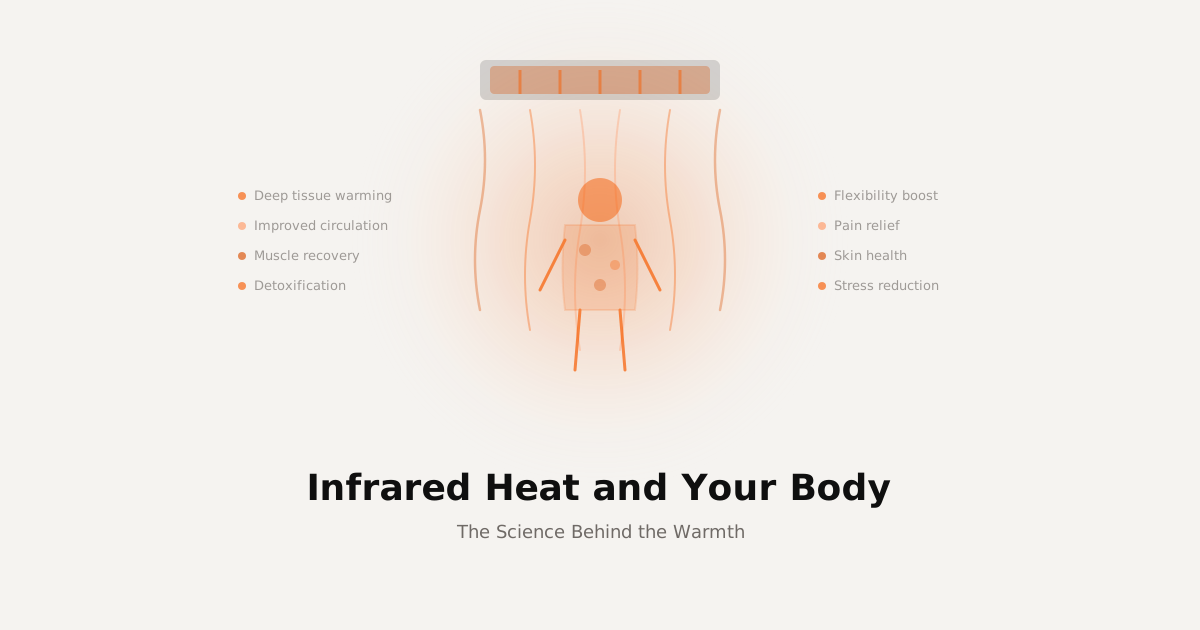
You may have heard about infrared hot yoga and thought: "Isn't that just a hot yoga class?" The answer is no — and the difference is more important than you think. Infrared heat affects your body fundamentally differently than conventional heating, and the benefits extend far beyond increased sweating.
What is infrared heat?
Infrared rays are electromagnetic waves with a wavelength just below visible light. They heat objects directly rather than the air around them — exactly like the sun's rays warm your skin even on a cold day.
There are three types:
- Near-infrared (NIR): Penetrates 1-2 cm into the skin. Stimulates collagen production and cell renewal.
- Mid-infrared (MIR): Penetrates deeper. Improves blood circulation and reduces inflammation.
- Far-infrared (FIR): Penetrates 3-4 cm. Reaches muscles and joints. This is the type most infrared yoga studios use.
Infrared vs. conventional heat
In a traditional hot yoga room (Bikram-style), the air is heated to 38-42°C. It feels suffocating, the air is heavy, and the body works hard to regulate its temperature primarily through sweat and increased heart rate.
In an infrared room, your body is heated directly. Air temperature is typically 28-35°C — significantly lower. But you sweat just as much (or more) because the heat works from the inside out.
The difference feels dramatic:
- You can breathe freely — the air isn't overwhelmed by heat and humidity
- You feel energised after class, not exhausted
- You sweat deeper — infrared sweat contains more heavy metals and toxins than surface sweat
"The first time I tried infrared yoga, I was surprised. I sweated more than ever but could still breathe. It was a total gamechanger."
What does the science say?
Research on infrared therapy shows:
- Improved blood circulation: Far-infrared dilates blood vessels and increases blood flow by up to 30%
- Reduced muscle soreness: Studies show faster recovery after exercise with infrared exposure
- Cardiovascular benefits: Regular infrared sauna use is associated with 40% lower risk of cardiovascular death (Finnish study, 2,300 participants, 20 years)
- Pain relief: Effective against chronic joint pain, fibromyalgia, and muscle tension
- Skin renewal: Near-infrared stimulates collagen production and improves skin elasticity
Who should try infrared yoga?
- Those who find traditional hot yoga too intense: Infrared is gentler but equally effective
- Athletes: The combination of yoga and infrared accelerates recovery
- People with joint pain: The heat soothes and increases mobility
- Anyone wanting to detox: Infrared sweat is deeper and more cleansing
Try infrared yoga
Yoga Bible offers infrared hot yoga in our specially designed room. Read more about our Hot Yoga concept, or book your first class via the schedule.
