


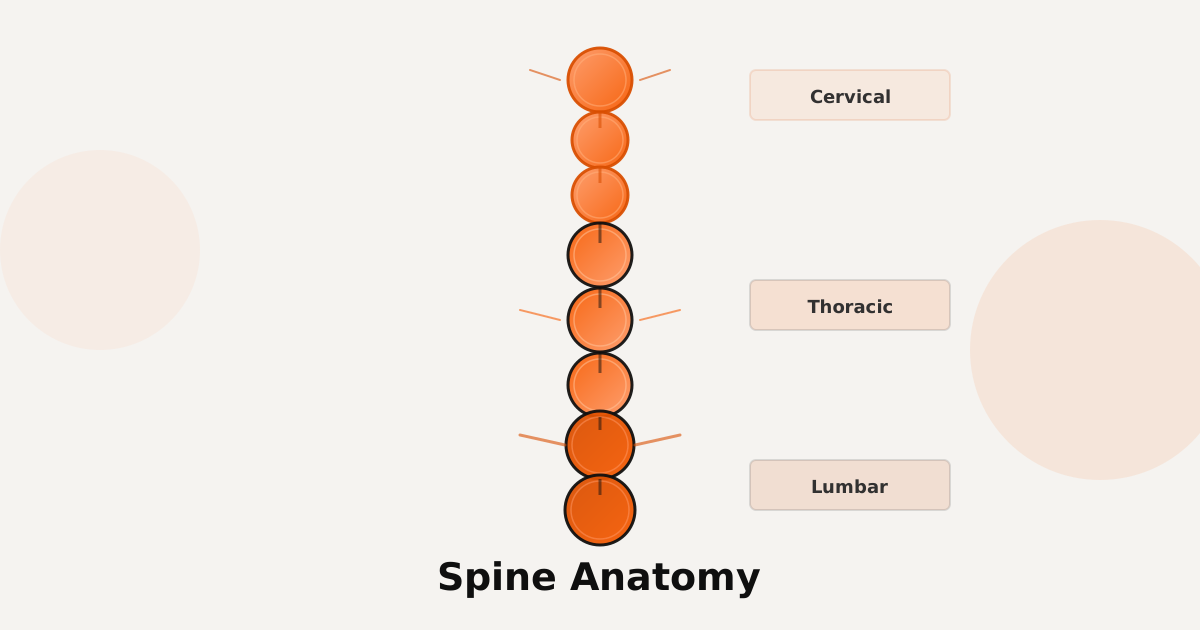
Most yoga practitioners think of the spine as one thing — a long arch that bends forward, backward, and sideways. But the spine is a sophisticated structure with 33 vertebrae, 23 discs, and four distinct curves, each moving differently. Understanding this changes your practice.
The four curves
The spine isn't straight — it has four natural curves:
- Cervical spine (C1-C7): The neck. Lordosis (forward curve). Great freedom of movement — rotation, flexion, extension, lateral flexion.
- Thoracic spine (T1-T12): Upper back. Kyphosis (backward curve). Limited extension due to the ribs — but this is exactly where we want to create more movement in backbends.
- Lumbar spine (L1-L5): Lower back. Lordosis. Most mobile in extension — which is why the lower back collapses first if you don't actively distribute the movement.
- Sacrum & coccyx: Fused vertebrae. Provides stability to the pelvis.
Why this matters for backbends
In a backbend, the body will automatically bend where it's easiest — and that's the lower back. But the goal is to distribute the extension evenly, with special focus on opening the thoracic spine.
Thoracic extension is limited by the ribs and natural kyphosis. It requires:
- Shoulder blades down and in: Creates space for the thoracic vertebrae
- Sternum lifted: Activates the deep back muscles that open the thorax
- Lower back stabilised: Core and glutes prevent excessive lumbar extension
"When I understood that my lower back was too mobile — not too stiff — it changed everything. I stopped pushing the lower back and started opening the chest."
The discs: the spine's shock absorbers
Between the vertebrae sit intervertebral discs — soft structures that absorb shock and allow movement. In extension, the front of the disc is compressed while the back is stretched. If the movement is too aggressive or too concentrated in one segment, the disc can bulge or herniate.
That's why we always work with gradual progression and never push through pain.
Learn more about your spine
In our Backbends Course we start with anatomy because it's the foundation for safe practice. You'll learn to feel the difference between lumbar and thoracic extension — and how to steer the movement to the right places.
